We have different teams that are responsible for identifying and coordinating the technological needs and requirements of users and different departments; and for designing, coordinating, and implementing solutions.
The IT area supports different products and services of the company, for this reason, its collaborators are in different teams.
Before starting with the details of how the IT team is composed, it is important to highlight the rules that guide all collaborators.
Rules
The IT team manages rules in the development of its activities that seek to align everyone to the team culture:
- There are no unnecessary questions, it is better to ask one or a thousand questions than to assume.
- Infinite tolerance for error but zero tolerance for failure, understanding failure as anything that goes against values and people.
- We trust in people’s judgment.
Pillars
The bases of our teamwork are:
- Methodology
- Communication
- Focus
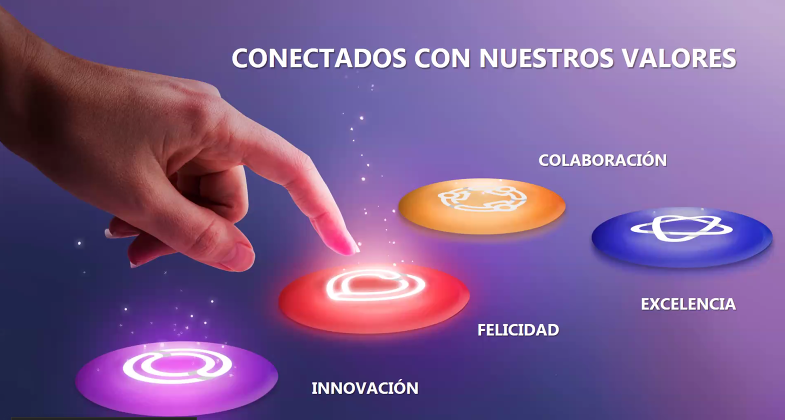
Teams, Organizational Chart, Positions and Functions
Equipment
The IT team is divided into different areas that cover the technological operation of the company, as shown in the following chart.
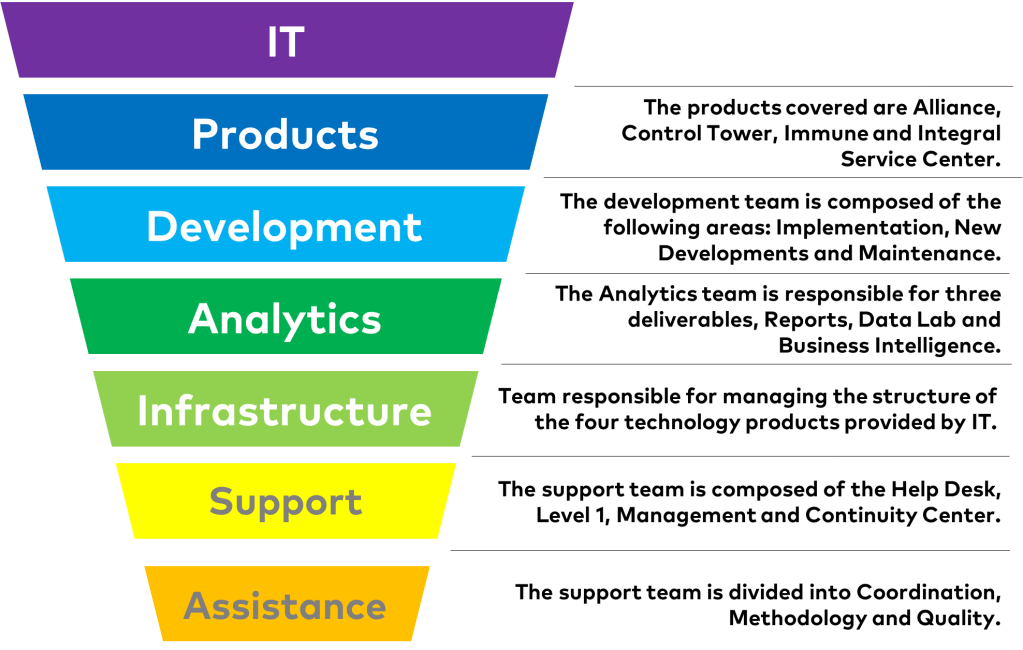
- Corporate Support, is responsible for structuring, communicating and maintaining the processes in the operation of IT equipment, taking into account best practices, technological products and the needs of internal and external customers. It is also responsible for providing users of the technological products developed by IT with a single point of contact through which to resolve and/or channel their requirements and guarantee their quality. It is composed of the Coordination, Methodology and Quality team.
- Support, is in charge of solving needs regarding the use of technological products inside and outside the company. It is made up of three teams:
- Help Desk, is responsible for providing Alto’s employees with a single point of contact through which their needs related to the use of resources and services of technological platforms are resolved and/or channeled, always according to a standard adopted by the company.
- Level 1, provides assistance to end users (customers) of the technology products (Alliance, Movup, Checks and Immune) on the use of these products. It also provides first hand response on internal and customer requirements on requests to IT.
- Management Center, manages the first contact with customers and assists in the integration of information from the different processes in order to provide our customers with services that meet their expectations.
- Infrastructure, team in charge of managing the infrastructure of the four technology products offered by IT.
- Analytics, is charged with using statistical analysis and predictive modeling to establish trends, find out why things happen and make an informed estimate of how things will develop in the future. It is made up of three teams.
- Reportage
- BI
- DataLab
- Development, This team is in charge of designing, maintaining, developing and implementing new models, software and technologies in the different technological platforms of the Alto Group. It is composed of three teams:
- Implementation
- Maintenance
- New developments
- Products, the equipment described above is present for each Alliance, Movup, Immune and Checks product.
Organization chart
The general organization chart is shown, for more information review the collaborators base.
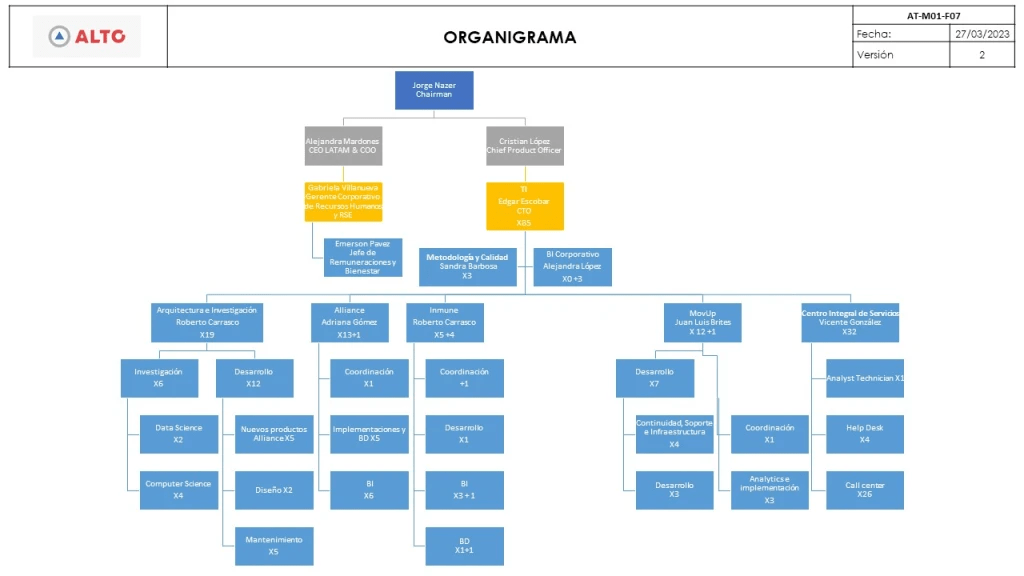
More information This information is in Spanish, if you require translation you must submit the request at the following link: https://soporte-ti.atlassian.net/servicedesk/customer/portal/14/group/83/create/868
Positions and functions
The IT team is divided into the following types of positions:
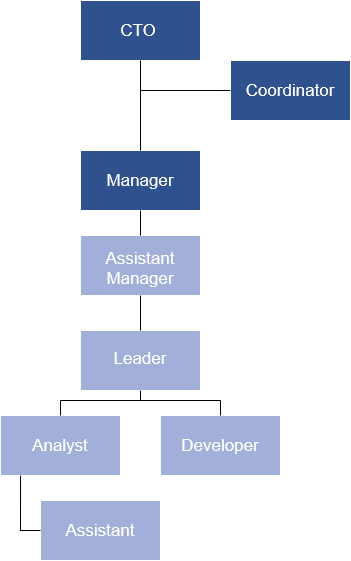
- CTO, his mission is to define and implement the company’s technological strategy, aimed at improving the final product/service in terms of quality, continuity, efficiency and security.
- Manager, is in charge of developing new products and incorporating new technologies; continuous quality improvement of current products (redesign of parts), defining and directing the area’s human and technological resources, defining the area’s objectives and managing suppliers.
- Assistant Manager, his mission is to ensure that the technological platforms implemented for the company operate without interruptions, updating and developing the necessary requirements, as well as maximizing the use of technological resources in order to meet the various information needs of the company.
- Leader, is responsible for ensuring that the different tasks of the team are developed within the scope, costs and quality established in the deadlines with the least amount of inconveniences, anticipating possible problems or deviations and making corrective decisions or proposing alternatives to management.
- Developer, must participate in the programming/implementation process having as input the software specifications and adjusting to the times and standards of quality and work of the organization and the area.
- Analyst, is responsible for finding patterns among the data, in order to obtain all possible information from them, generating different technological tools that generate an outstanding multidirectional impact on the future of customers.
- Assistant, its mission is to execute the necessary support tasks to meet the delivery objectives in the products implemented by the analyst or developer.
- Coordinator, serves as a bridge between internal customers and the IT team, understands the need, the solution, reports progress and follows up.
More information (under construction, in the process of standardization of charges) This information is in Spanish, if you require translation you must submit the request at the following link: https://soporte-ti.atlassian.net/servicedesk/customer/portal/14/group/83/create/868
Training
The IT team manages a training plan, at the human resources level, which covers relevant aspects for the operation of the team, each of which is detailed below:
- Corporate
- Who we are TI
- IT Requests: internal (Development and support) and customer (“Tiquetera”)
- How to use Alliance (web and app)
- How to use Movup (web and app)
- How to use Check
- How to use Immune
- Information security policies
- Interns
- IT Methodology
- Technological (Position)
Evaluation and follow-up methodology
Internal evaluation
- Evaluation of semester objectives. More information This information is in Spanish, if you require translation you must submit the request at the following link: https://soporte-ti.atlassian.net/servicedesk/customer/portal/14/group/83/create/868
- 360º Evaluation, where the following aspects are evaluated:
- Work Experience
- Technical knowledge
- Functional knowledge
- Proactivity
- Follow-up required
- Productivity, Quality and Efficiency Indicators
- Meeting deadlines
- Responses under Pressure
- Communication skills
Benefits
Work by objectives allows to have a work plan that responds to goals with their respective activities, in teleworking mode, achieving decentralization of decisions, increasing participation, self-control and self-evaluation. In addition, employees feel independent and responsible for their tasks by identifying professional objectives, allowing a clearer evaluation of what is being done and, at the same time, having responsibility for the different products. Working by objectives is a very good strategy to be able to measure the various aspects related to the tasks to be performed, IT has the metrics of time, costs, and team results, it can also analyze the tasks, and make changes based on them if necessary.
More information This information is in Spanish, if you require translation you must submit the request at the following link: https://soporte-ti.atlassian.net/servicedesk/customer/portal/14/group/83/create/868
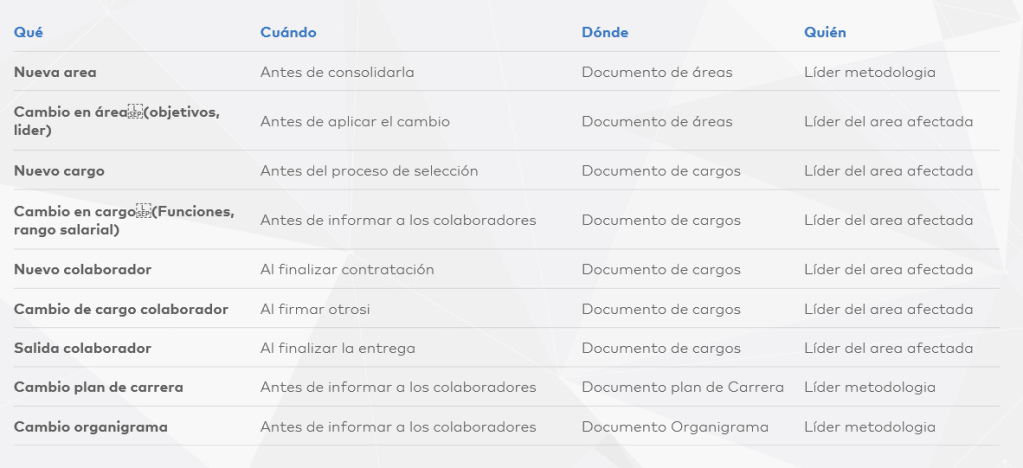
Maintenance
This item should be updated with the following events:
How much did you learn?
In the following link you will find questions related to the above explained.
HR Questionnaire This form is in Spanish, if you require translation you must submit the request at the following link: https://soporte-ti.atlassian.net/servicedesk/customer/portal/14/group/83/create/868
CLASSIFICATION: INTERNAL USE
Any printing or digital copy of the document is invalid. The user of the document must ensure that it is current before using it. This can be checked with the person responsible for the ISMS.
 IT Alto knowledge center